
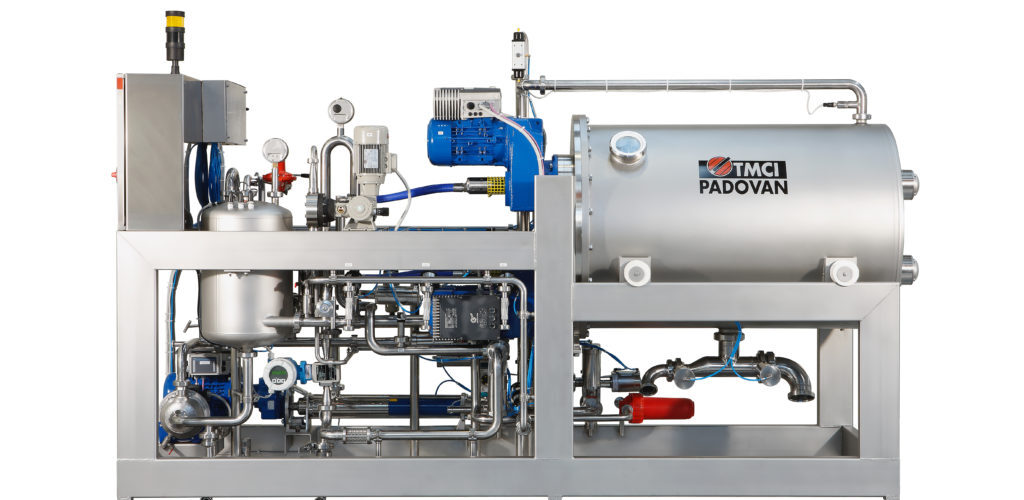
High solids crossflow filtration
Both cross flow filtration and traditional filtration use a membrane as a filtration medium and the change of pressure as a mechanical force.
The principle of cross flow filtration can be easily described by referring to this picture.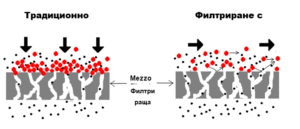
The flow of liquid (to be filtered) intercepting the membrane is not perpendicular to the porous bed, but rather tangential to it. In this way, the formation and the sedimentation of material onto the inner surface of the membranes, which causes the clogging of the pores, is reduced. It is therefore not necessary to clean frequently or, even worse, to replace the porous bed.
The product to be filtered is forced to flow under pressure on the surface of the membrane, carrying away the retained particles, so that the sediment layer (polarization gel) remains thin and the resistance to filtration low. This enables to preserve the filtration capacity for long periods. In cross flow filtration only a part of the product passes through the membrane. This part is called “permeate” or filtrate. The rest of the product flows on the surface of the membrane and comes out of the filtration system with a bigger content of solid parts, compared to when it was fed into the system. This part, called “retentate” is a consequence of the cross flow filtration.
A backflow of the filtrate (from the outside to the inside of the membrane), called “Backwash” or “Back-Flushing”, allows a further control of filling material sedimentation onto the surface of the membrane and has two effects: it reduces the filtration flow rate and creates a membrane with a higher absorption capacity.
For the above reason, it is possible to keep the filtration performance constant over time, even in case of liquids with a high turbidity and clogging capacity.
The separation by means of the membrane is obtained thanks to the dimension of the pores (screen effect).
Both rotary dynamic cross flow filtration and traditional filtration use a membrane as a filtration medium and the change of pressure as a mechanical force. The principle of cross flow filtration can be easily described by referring to this picture.
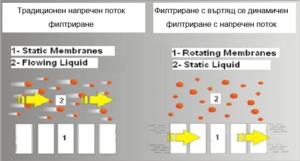
As in the traditional system, the tangent flow to the filtering surface is given from the liquid to be filtered, while in the new system the filtering element is dynamic (thus creating the tangent effect) and the flow is fed with a lowland speed.
С тази нова система се постига следното:
- This new system leads to:
1.
high speed in the product to be filtered to minimize the membrane clogging. In addition, the centrifugal forces acting on the encrusting material and continuously remove it outward.
2.
maximum efficiency during filtration, tangential velocity extremely high for a thorough cleaning of the filter surface;
3.
friction and flow are not related to each other as the friction is an operational function of the filter;
4.
energy consumption significantly reduced when compared to traditional filtration techniques; - supply pressure uniformly on the membranes;
6.
reduced pressure differential.
The membranes are microporous ceramic discs and are mounted on hollow shafts. The product passes through the ceramic discs, which are rotating and collected inside the shafts themselves, and then discharged into the filtrate tank.
A backflow of the filtrate (from the outside to the inside of the membrane), called ““Backwash”” or “Back-Flushing, allows a further control of filling material sedimentation onto the surface of the membrane, reducing the filtration flow rate and decreasing the porosity of the membrane itself. For the above reason, it is possible to keep the filtration performance constant over time, even in case of liquids with a high turbidity and clogging capacity..
Dynamos is the name of a series of cross-flow filtration units with dynamic membranes; there are manual, semi-automatic and fully automatic versions. These units use ceramic disc membranes specifically designed for filtration of products with high suspended solids content in various applications for food and beverage industry.
- Dynamos can be used in winemaking for:
- Wine/must recovery from clarification lees with products such as gelatin, bentonite, charcoal and other clarifying products.
- Recovery of wine from exhausted lees.
- Recovery of must from flotation lees.
- Dynamos can be used in the brewing industry for:
- Recovery of beer from exhausted yeasts.
- Recovery of wort from boiling residues (trub).
- Recovery of beer from dry-hopping residues.
- Dynamos can generally be used in the food industry for:
- Recovery of fruit/vegetable juices from pressing and extraction residues.
- Concentration of solid products such as food fiber, fruit/vegetable pulp, seaweed and other similar products.
- Recovery and extraction of flavors, dyes, active ingredients and/or other substances from plant material.
- Concentration and treatment of processing residues for the purpose of recovering wash/rinse water and concentrating residues to be sent for further treatment or disposal.
- Concentration and treatment of spent wash solutions for the purpose of recovering wash/rinse water and concentrating residues to be sent for further treatment or disposal.